
Tag Archives: onerecord

10 Year Plan for England’s NHS – Week One

The new “Ten Year Plan” shifts decision-making power from you and your family doctor to hospitals and technology companies. There are wordings from the political leadership about patients owning data, but the depths of the policy machine seems to suggest there be a day soon when you ask the NHS to opt your data out of being used for purposes other than you care, and it will do less than it does today.

Any plan is an exercise in tradeoffs, but leadership is about making and explaining those hard decisions. Mr Streeting did neither.

Critics of the pre-pandemic 2020 planning said the system had no real plan—barely even a plan to make a plan. The new plan is barely a plan to have a plan.  Even the Blair Institute found it underwhelming. The tradeoffs needing leadership were ducked, epitomised by the complete absence of a “delivery” chapter.

It is delivery that matters for patients – 150 pages of irrelevance unless there is delivery. 

New ideas are scarce – it largely rehashes previous plans, sprinkled with some AI ‘fairy dust’. But the fact that the Government has no idea how to deliver any of it means they at least don’t have to be talked out of an entrenched position, they can be steered out of their confusion by those working in the wider public interest (which will require listening to more than the hospitals and tech suppliers that confused things in the first place).

It is clear some decisions have been made:

1) Single Patient Record on Palantir’s Federated Data Platform

One of the pre-announcements was Palantir/FDP doing the maternity care monitoring, and the 10YP (page 48, bottom right) says that will be done with the data in the SPR – so Palantir will run the SPR with all data being owned by the politicians of the day, including full DNA sequences. Perhaps the incoherent “request for information” from a couple of months ago was the sham some suppliers suspected it was.

The political decision appears to have been made and withheld from the public, which does not bode well for public trust in the 10YP. As with the US, Palantir came first for babies. 


As the 10YP says: “The NHS never has the right to keep the public in the dark. That it so often does so reflects the centralisation of power and disregard for patient voice we identified in chapter 5.”. NHS England has recently decided that more data projects can be hidden from the public  (items 5.2, 5.3, 9). 


If the “app first” AI led vision works, your NHS app doesn’t need a Single Patient Record at all, it can connect data from multiple places and display it all for you. Your device can run those algorithms and you can make an informed decision about prevention, rather than having all the data under the control of the Secretary of State for him to run his algorithms and tell you that you’re fat. The Dash Review on patient safety, written by the now-Chair of NHS England, remarkably doesn’t mention the Single Patient Record at all, talking of doing what it needs in the Federated Data Platform (using data would be in SPR if both weren’t in Palantir).

The only thing moving all your health records to Palantir uniquely adds is the ability for Mr Streeting – and his Reform successors – to run algorithms over your record to implement political decisions about your care. If the decisions were in your interests, your NHS app could run them locally for you.

2) Is your Politically Controlled Single Patient Record yours?

If you “own” your record, that’s good, but you have to actually have the power and control that come with owning something.

In most places in this Plan there is a lot of repeated text promising the same things over and over; but the section about the SPR being under patients’ control and patients being empowered is curiously not repeated in the same way the AI hype is. “Ownership will be with the NHS or patient” suggests that the patient isn’t in control when the NHS doesn’t want the patient to have a say.

You have no right to delete data from your official medical notes – even if it was a phase in your life long ago with temporary troubles, or a hallucinating AI summariser added some fiction about a consultation, once something has been added to your medical notes it is impossible to remove. It will be there, visible wherever the NHS logo is seen to any doctor who looks and read by any AI tasked to run.

Some exact quotes:

  • (pg 11) “for the first time ever in the NHS, give patients real control over a single, secure and authoritative account of their data and single patient record to enable more co-ordinated, personalised and predictive care”
  • (pg 11) “More fundamentally, we believe fast, transparent and secure access to our own health data is a right, not a privilege.”
  • (p48) – We have spoken to the public around the country about how they want their data to be used. We heard their desire for a rigorous approach to privacy and security, which will inform our redesign of the opt-out system”

And then all the caveats appear: 

  • (p48) “We will reform the legal framework to allow for health data to be used to improve the NHS and for research that benefits its patients – including, through the Health Data Research Service announced by the Prime Minister in April 2025.”
  • (p116) “Deidentified data will be made available to scientists”
  • (p117) “We will work with the public as we develop the details on this, but for the avoidance of doubt, this will never mean compromising on patient privacy. Data ownership will remain with the NHS or patient.”
  • (p117) “we will explore ways to derive commercial value from access to anonymous health data as well as from public assets like advanced analytics”

If patients do not want the data that they “own” to be used, then it should not be used. 

In one place the Plan says patients will have “real control” over their record and “data ownership will remain with the NHS or patient”. The “or” implies that the NHS can continue to make decisions the patient objects to.

The contradictions and caveats in the 10YP suggested the current mess of loopholes is likely to continue, with opt outs being ignored two thirds of the time today. The only differences under the SPR will be much more data and there will be less scrutiny from the GP Profession with their obligations to you as a patient.

The work to “reform” the National Data Opt Out has been indistinguishable from push-polls encouraging patients to let NHS England do whatever it likes. With the abolition of NHS England, that will become the Department of Health in England, and the politicians in charge are deciding what they can do with your entire health record. And the answer seems to be anything they wish. The proposed legislation has to be water tight, and there is no track record of the hard decisions being made that will make it anything other than another dodge of responsibility.

Taken together, there is likely to be a day in 2026 when opting out will do less than opting out does today.

What Government does is as important as what Government says it should do.

3) (Lack of) delivery is political
The “delivery” chapter is entirely missing

The plan assumes patients should only have the agency that the Secretary of State is willing to give them, and the plan entirely relies on the Secretary of State always having the interests of Wes Streeting and never the interests of Andrew Lansley. 

The tech companies running digital services can impose changes on you and you can accept the new terms or not use the private service offered on a take it or leave it basis; with public services you have a view.

The plan puts the tech guys on top; mere patients will use apps and will like it. Patients must use 111 chatbot to get permission to visit A&E and will like it. Their GP practice site will be closed and move to a hospital managed neighbourhood health centre about as local as the job centre (there’ll be about the same number of both). These changes are good for hospitals and tech cos – the primary authors of the plan – but like all the long known good ideas, the hard bit is delivery. There is scope for new national digital services – a high quality digital service like SH:24 could easily be a national service, the barriers are all on policy and the choices of structures. The most obvious ban that is likely to be removed is cross selling commercial services to NHS patients who shouldn’t have to pay for any of them. Using the NHS app for your GP will become more like your NHS dentist where treatments are increasingly private.

It’s entirely rational for a hospital to want to manage their own front door, when they don’t have the ability to move people out of hospital and into social care at one end, they’ll feel the need to restrict access to A&E at the other. That it’s rational for the hospital to want it does not mean it is the only answer, or that it’s rational for the Secretary of State for Health and Social Care to say that is the policy he is going to deliver. But when you give more power to hospitals, what you get is more powerful hospitals wanting policies that make it easier to run hospitals. 

There will be an election by 2029, and it will be a politically open goal for the opposition(s) to say “we’ll remove Wes Streeting’s ban on visiting A&E without an appointment”. And after Labour lose, your local neighbourhood health centre will go the way of your local sure start centre (but since it’ll be privately run, those in richer areas will stay for private patients only).

Wes can force everyone’s data into the Single Patient Record, he can pass legislation that lets him do whatever he likes, and micromanage your health using algorithms and sensors on your device. There is no commitment to all services remaining on the NHS.UK website that are available on the app, so those without the app can still access all services.

Much of the tension and challenge in projects comes from delivery choices. The vision was grand, the delivery is often something else. The plan has ignored all the delivery choices and promises little prior to 2035. 

Innovation

“Ambient Voice Technologies” may sound like a harmless innovation until it’s reworded as microphones recording every consultation, and patients simply stop telling their doctors the sensitive truth. The AVT suppliers will get pressured by their lawyers to first include all transcripts in medical records, and then all audio recordings because safeguarding and safety.

Time moving forwards means we learn things, while the plan assumes Mr Streeting will learn nothing during the period; which may be true but it’s a damning indictment of the expectations set by politicians who want to be data controllers for your health record.

Politically it is difficult to rely on magic beans that do not yet exist. But the plan assumes that none of the money going into health research will deliver anything. The scope for vast quantities of budget to be freed up for innovation moving major treatments from hospital to GP and pharmacy is entirely missing. The plan contains limited recognition that any innovation other than AI will occur before 2035, and leaving hospitals in charge of everything will mean that delivery and innovation only happens in hospitals, while innovations outside hospitals are slowed.

It’s incoherent for the plan to assume that any AI the authors like will work perfectly in all cases, while nothing else will advance at all. CRUK pour money into curing cancer and the mRNA treatments show promise, Google DeepMind says their new drugs will be in testing this year, something might work by 2035, but there’s no certainty it will work but it would be astounding if nothing worked. The dementia charities have realised fraud put them on the wrong track and are now looking at new models of treatments; blood tests for everything are starting to offer some degree of delivery. If this plan was written 5 years ago today, we would not yet know whether the mRNA vaccines for covid worked in the way we do now. A plan written 10 years ago would have lauded social media for informing and engaging patients in communities, rather than addressing the new patients with new mental health needs. This part of the “plan” is not a plan.

Hospitals will do whatever they are resourced to do for particular conditions, GPs are the only part of the NHS that treats the whole patient and has a responsibility to you as a human not you as a condition. If GP loses influence over data, your data will be treated as a collection of interesting conditions more than data about you as a person. (this is the basis of the HDR unconsented cohorts project we’ll cover in future)

Delivery is possible

“It won’t be easy” says the Prime Minister in the introduction recognising the scale of what should follow, but wrapping up his plan Mr Streeting says “there are moments… when our choices define who we are” after dodging all of those choices.

The cowardice of cutting the delivery chapter shows how weak the plans are – there is no plan for delivery. But it does mean that the good bits of the plan can be moved forward, but companies will push forward the most profitable parts. The thinking of the Department of Health in England is that imposing passports everywhere will be the solution to everything; the Home Office and Blair Institute argue that doesn’t work.

Over the next few weeks, we’ll look at how the policy intent can be delivered in ways that ensures that every flow of data into, across and out of the NHS and care system is consensual, safe, and transparent, showing there need be no conflict between good research, good ethics and good medical care.

===

In addition to our annual-ish newsletter, you can also join our free substack to get emailed whenever we post some news or commentary.
10 year plan: say goodbye to your data (and say goodbye to your GP)

When the whole 10 year plan comes out tomorrow we’ll start reading it, but the night before what’s out is the last press release before the 10 year plan – ie only the bits that Government most wants to talk about because they think they’re the best parts… 

Mr Streeting’s 10 year plan will replace your GP surgery with a “neighbourhood health centre” in the same way you have a “neighbourhood job centre (plus!)”, with the service promises that applied to your local sure start centre (and it’ll go the same way). 

The “single patient record” controlled by the Health Secretary will replace your GP record with a politician owned medical history, taking control of all the medical notes made by doctors across your life. Everything you’ve told a doctor in the last 35 years is in those notes – it may have been sensitive and important at the time, and it’s all still sitting there. 

Your GP has responsibilities to you over your health records; the Secretary of State will do whatever the politician of the day wants, because the data controller for your medical records is the politician of the day. They will make decisions for political reasons.  

Your GP writes your notes for the importance of your health and future treatment. But the creepy centres will be incentivised to confuse dystopia with efficiency and use “ambient voice technology” with microphones in the rooms to transcribe everything and have an AI summarise it for your permanent notes. “Clinical safety” will require a full transcript is kept to protect the organisation, and then the audio recordings will be kept because they too are needed to protect the organisation. The effects on individual patients matters less to the hospitals – your GP receptionist might feel like a bit of an ogre at times, but they work for your GP who has some responsibility to you. In contrast, the neighbourhood health centre’s bouncer works for someone far away, and hospitals are barely responsible to anyone, which is why Mr Streeting wants Palantir’s AIs to monitor every birth in every maternity unit. 

If you want any doctor to see the sensor data recorded by your smartwatch or phone (how you sleep, how you walk, how you’re breathing or your heart rate) you’ll be required to share it all with the national health record and Palantir in order for any of it to be seen by your doctor. Mr Streeting wants to know how often you masturbate while wearing a smartwatch (or get laid, and yes, his algorithms can tell the difference), and he’ll share how often you go for a walk with DWP and sell it all off to anyone who wants to buy all the data..

As parents know from their children’s health, Government finds it easier to blame families for kids being repeatedly off school with illness and not do prevention to avoid kids getting sick in the first place. Kicking people off PIP doesn’t make them less sick, and closing GPs doesn’t decrease the hospital backlogs, but it does help hide them.

Details aren’t out yet

Today is the best day the 10 year plan will have in its lifetime. We’ll read it all when it’s out and see what the consequences are.

Perhaps there’s no real need to worry, because Mr Streeting will u-turn like all his cabinet colleagues, and should do because the good things they want can be delivered in other quicker ways. As we saw in our recent look at community health centres, policy says that in theory GPs can refer for a scan directly, but the hospital running the centres says in practice they can’t. But the hospitals must have forgotten to mention that in meetings.

Writing the 10 year plan Mr Streeting only listened to people who run hospitals, so the plan calls for hospital outposts to replace your GP practice (and is why GP isn’t getting more money, and why the priority is “from hospital to community” not “do more in primary care”. Your hospital will come into the community for a while, other services will go away, and then the hospital will withdraw once again.

We’ll be here.

===

In addition to our annual-ish newsletter, you can also join our free substack to get emailed whenever we post some news or commentary.
Government’s plan to genome sequence every baby at birth from 2035

[this post was published in June 2025. In October, GeL announced they had sequenced 20,000–25,000 babies, with only one confirmed finding so far in 60 possible findings, and sequences will be stored in a controversial supplier.]

If your baby is born with a rare disease today, or might have one of those rare diseases, the NHS can and will already DNA sequence them to help figure out what’s wrong. When Wes Streeting “announces” every baby should have their DNA sequenced at birth, that’s not a new revelation in a gift to the Telegraph (chosen because of his leadership ambitions; here’s a free to read version or BBC). 

What is new is that Government wants to sequence every newborn, all the kids who aren’t sick, because it ‘might be useful’. It’s definitely good for those who sell sequencing machines; it’s good for Palantir and Amazon who will be processing all this data, and it’s the preclude to the 10 year plan for the NHS which will move money from your human GP to prioritise AI chatbots that will always demand ever more data. 

Genewatch UK have detailed resources on the sequencing process and the long history of this proposal.

DNA is yours for life, not just for one government

This will be the DNA sequence of every baby born in the country, and it will be going into the politically controlled health record in the Platform they bought from Palantir – so Labour are relying on the stability of Donald Trump and his allies (today!). 

Will your kid’s DNA be as well protected as Wes Streeting’s DNA? All these records have to be kept safe and secure. Which means stopping the Americans copying it off their servers, because they always do what they say, it means UK Ministers can’t ever make a bad decision, which never happens, and it means stopping the Chinese from stealing it – do we want to still have a Secret Intelligence Service in the 2050s? Data always leaks. The UK Biobank is still vigorously defending giving half a million genetic records to eugenicists who have a startup doing designer babies. This data will be available for that research too.

The data won’t help your kid if they get sick later

If you needed one of the supposed targeted treatments, the NHS would do the tests today.

The new plan is not about curing your cancer, and it’s not even going to be used if you do get cancer. If you come down with cancer, where sequencing can be useful, your doctors will want to know your DNA sequence but they also want the sequence of your cancer, and those need to be done on the same machine ideally at the same time, and you need to be there for that anyway. Those who’ve had their cancer sequenced in the past would have it sequenced again .The argument that this’ll be so cheap to be worthwhile for newborns works here too – it’s why cancer isn’t the example, instead it’s a disease almost no one gets.

The assumption of the tech bros who have captured Wes Streeting’s vision is that health advances will flow in line with their business plan, and then no one else will ever compete with them again. It’s good for a business plan but not for the NHS. 

By the end of this Parliament there’ll be a bunch of cancers that you can cure in your cat by taking them to your usual vet – it’s up to Wes Streeting whether those same cancers will also be curable in people, on the NHS, but it’s politically indefensible not to. 

Sequencing baby blood spot tests

For nearly a decade the baby blood spot test cards have been retained to sequence every kid born in the last decade. If this was actually useful, they’d have done something with it. Instead they’re waiting for a moral panic to go back and pay even more money to sequence the lot. It clearly had no clinical benefit.

The Home Office will want the data as those kids start to become of interest to law enforcement and they’ll probably find the money. Once the data is sequenced, it’ll be available in your “patient passport” where parents may be quite surprised to read that “daddy” isn’t.

10 year plan

Instead of focusing on patients, Wes Streeting’s 10 year plan will be about managing you via data dependent algorithms designed by politicians not driven by doctors; decisions that mean you can’t use the NHS app unless it can copy any sensor readings off of your device that politicians want, and they’ll get shared across Government and beyond. 

The “high” light of replacing your GP with a chatbot is that you can fool all of them into adding whatever you like to your medical notes, including that you should get the really fun drugs; the sort of thing a human GP wouldn’t fall for but the AIs do.

I’m sure Wes Streeting has had some great feedback on his proposals – the tech companies will love it, research will love it, it doesn’t detract from medicine, and which patient group opposes something they’re told would help treat babies. As with all patient engagement, it’s what they’re not told that can destroy a project because of the deception.

===

In addition to our annual-ish newsletter, you can also join our free substack to get emailed whenever we post some news or commentary.

Lots of (contradictory) information on the politically-controlled Central Health Record (and some questions for suppliers, DH/E, and probably you)

This Government believes AI will impact everything, and because it believes AI will impact everything and the Silicon Valley hype, the Government believes in the coming robotics revolution and can slash care worker visas because care worker jobs will “soon” be done by robots (remember to say thank you to chatGPT). (“Soon” in migration policy terms means within the ~14 years that it takes for a change in migration policy announced today to go through policy, legislation, implementation, and then the 10 year pathway for leave to remain). What they’re doing for carers they’d like to do for doctors, which needs a database of those AIs and robots can read and write to, which is a central health record under the control of the Department of Health in England. 

They call it the “Single Patient Record, and the Department of Health in England has asked companies for information on what D/E can buy to run the record they’ll force you to have.

Published in advance of the 10 year plan because lead times are so long, the Department of Health in England is asking how suppliers will implement an unpublished plan, but they’re offering 8 pages of ideas that are “non-exhaustive and subject to change” “working vision” “draft definition” “early draft use cases” where “Nothing within this document or the broader market engagement exercise shall constitute a commitment” because “NHS England is at an early stage of scoping the Single Patient Record (SPR). The initial aim of the pre-tender market engagement is to gain innovative ideas from the market to ensure that NHS England considers all options available”.

It appears to be the belief of the Department of Health in England that FDP/Palantir will take any data that they want from the Single Patient Record, using the authority of the Secretary of State to Direct that it be provided. We’ll have more on the consequences of that in time, and other assessments of the impact of Labour’s vision for the future of your interactions with your doctors and of your care.

This (long) piece will look solely at the data and the new database being bought, and there are a lot of moving parts that don’t really join up yet (which is why it doesn’t look like it joins up, because it doesn’t). None of the proposals in this document will happen to your data until 2026 or beyond if anything causes you immediate concern, you can join our mailing list to hear directly from us if or when there is anything that may need you to take action.

This new database could be done well, it could help and empower patients to get better care, cheaper, whatever that means to them. What those treatments are the end of this Parliament will be different to what they were before the election – Mr Streeting knows that by the end of this Parliament in 2029/2030, it’ll be increasingly normal for you to be able to take your cat to the vet to have your cat’s cancer effectively cured. Precisely which cancers and how much it will cost are currently uncertain, but decades of research are starting to show results for humans too, and politicians know it will be morally, practically, emotionally, but especially politically intolerable for you to be able to have your vet cure cancers in your cat, when you and your loved ones cannot receive equivalent treatment on the NHS.

A “single version of the truth” that works would start from a fundamental rethink that placed patient experience at the centre, because, as Mohammad from PKB puts it: “the patient is the only one in all the different meetings”.  Instead, the SPR as envisaged by the Department of Health in England puts a Government  Department in every consultation you ever have and every piece of data you ever record.

“In the future”

The annex of the “Full RFI document” with the details is not a coherent vision of “the future” for the NHS, or the future of your health, and it’s certainly not a rational considered assessment of what the NHS would look like if it was started from scratch today. Instead, its a bucket of ideas, with the level of detail you may find on a postit note in an over-caffinated workshop where “initial ideas” are accepted as sacrament without any introspection or insight. It’s as if DH/E typed up every post-it note and asked decided to see what they could buy. It’s unclear who they invited to those meetings to write things that went into the document. Not us, but clearly the HDRUK-Service added their wishlist which reflects the culture of biobank and the everyone database. Whether DH/E will apply the NDOO to prevent “unnecessary processing” of “pseudonymised” personal data is unclear, but today DH/E actively refuse.

Some early hints of possible change for the better

medConfidential welcomes the suggestion for features like:

  • “I can change my choices for certain uses of my data held within the SPR for users which do not provide services directly to me, for example the use of my data in research” (but “planning” is missing?)
  • “I can view which users (for example, identified by role and organisation) have accessed my care record and the purpose for their access of my record”

With the number of caveats in the document about no commitment to anything, it is far from certain whether those ideas will get implemented to protect patients – NHS England has repeatedly sided with creeps against their victims. Maybe the new Department of Health in England will do better – time will tell, and we’ll keep a close eye on this because “in the future” can always be delayed.

Government choices not your choices

DH/E seem to have decided you must have a politically controlled central health record – there is no evidence you will be offered a choice and suggestions you will not get a choice because “activities are held back by the lack of a single record”. Existing records are not comprehensive, are read only, and present data from care settings in tandem rather than creating a single version of the truth” and needs “different providers, as well as NHSE, to all have read and write access to a shared, comprehensive record built from multiple provider records”. 

That is, after the abolition of NHSE, the Government will be able to write things to the “single version of the truth” about your health, replacing your doctor’s records to avoid a “tandem” record – which may be the end of TPP/EMIS for GPs and DH/E imposing their monopoly – yet it also says “the data in source systems such as GP and Trust EPRs will remain the system of record for clinical activity, providing the single version of the truth”. So there will be at least three different “single” versions of the truth, plus whatever Government algorithms write based on the data you give them (including from your smartwatch if you want to share that with any doctor you have to share it with all of them)

Politicians usually believe they are doing the “right” thing. Mr Streeting argues that the record will belong to the patient, and be under the patient’s control, but when they have ADHD, or have some condition that the politicians of the day treat like a political chewtoy the same way homosexuality was treated in the passage of section 28. A politically controlled central care record is not yours, it is the plaything of the government and of politicians, which may be increasingly understood very differently in 2025 than it was when Mr Streeting was thinking his thoughts over dinners with lobbyists while in opposition. “Don’t say gay” becomes “don’t do anything” (but you might die).

Replacing your doctors with not-your-not-doctors

The theme that flows throughout the wish list is for fewer doctors and more not-doctors – whether AIs, algorithms, not doctors. “Care delivery tomorrow is predicted to be much more digitally enabled, supported by artificial intelligence (AI) and algorithms that identify risk” with items written by “patient clinical algorithms” in “Primary and secondary care operators” (who are different to “clinicians”).

When decisions are made by algorithms and AIs, you wont be able to know why you ended up so far back on a waiting list managed in Palantir. One of Mr Streeting’s first acts in office was to restrict care for people he believed inappropriate to receive it. Simultaneously, NHS England wants to reduce the ADHD drugs bill, and others believe PreP encourages immorality, and those contentious debates are before we get to the routine questionnaires on alcohol, smoking, or other activities that can impact health but are subject to political ideologies. When you’re answering questions from the Government rather than your doctor, the answers may have greater effect. 

Government is trialling giving weightloss drugs to people on Universal Credit “to prevent them holding back our economy”. The Single Patient Record existing is a prerequisite for giving DWP access to it, and this may be why you can’t choose not to have one. No patient should be forced to choose between their health and their privacy, but it may become the view of Ministers they should have neither.

“Single version of the truth”

The proposal expects tech suppliers to create a “single version of truth”. While that is a clear political aim, and a thing that could be put on a reform leaflet, the issue is not technical nor data. It is not a lack of data that leaves people stuck in hospital due to a lack of social care capacity, it is not a lack of data that leads to the NHS assessing needs at one level and social care funder only being able to afford/provide something lower. It is not a lack of data that leads to a particular diagnosis and referral by their GP being bounced around while hospitals fiddle their waiting list figures.


To be useful, a “single version of truth”  needs there to be a version of the truth that is consistent. 


It can be done, but the systems must serve the patients and the staff, not attempt (and fail) to impose decisions against other incentives.

Mr Streeting claims that the record will be “owned by the patient” and DH/E leadership describes it as belonging to the patient – “theirs not ours”. It’s unclear how that squares with being forced to have one. Either way, will a patient be able to change any entry within “their” database? Will they be able to block access to their smoking, drinking, sexual activity, IVF history? Or that embarrassing condition that still afflicts them? When the algorithms think you’re obese, do some people get to fiddle the figures so the AIs stop hassling you about it? Or will they require you to send a selfie every time so they can guess it themselves? In short, will “your” record be a record about you not for you? There are legitimate reasons to remove entries that are fundamentally wrong, but there are also sometimes reasons not to. That is a very human decision, and reasonable people can disagree. Can a patient write their own diagnosis to the database when very drunk and alone at 4am in the morning? Will the system suggest they just go to sleep instead?

Your doctors may benefit from more information, but the plan is for “artificial intelligence (AI) and algorithms that identify risk and can personalise care and promote preventative activities based on an individual’s history”. As with FDP, such “AI and algorithms” will be imposed nationally. Today systems “present data from care settings in tandem rather than creating a single version of the truth” and instead “In the future: the SPR will provide a single version of the truth by integrating data across settings, enabling patients and health care professionals to work from the same record and to both see key primary and secondary care NHS interactions, as well as autonomously prompt actions to occur.” Simultaneously, while the large corporate GP chains and hospitals have limited liability when such algorithms go wrong, your local family doctor continues to have unlimited personal liability (and the only way they can get the protections the chains have is to walk away from their practice and patients entirely). 

There are the usual vague promises of reducing patient harm that also get made (but not delivered) for FDP. Ensuring contraception for any woman receiving sodium valproate was supposed to be done by FDP, but hasn’t; there are ways to do it, but legitimate use cases mask the much larger desire to replace doctors with algorithms that shift the burden onto patients who must answer questions over and over, just in case something might have changed. How many times is it appropriate to ask about contraception? Given the risks, one more will always be better…

There can’t be a single version of the truth in a computer when there isn’t one in the world

None of the compromises are discussed in the document – everything is perfect, no tradeoffs are required, because it’s clear that the most important opinion is political not clinical.

Discrepancies between primary and secondary care aren’t because they don’t like each other, but fundamentally different assessments of need. Part of this problem manifests in “Advice and Guidance” dance that DH/E are doing between GP and hospitals. 

Ambulances don’t queue outside hospitals because social care can’t see NHS records, they get backed up because what social care can do doesn’t line up with what NHS needs it to do. Data is a more politically palatable and tractable excuse than insufficient funding. DWP doesn’t force people through the brutal PIP process because the NHS wont tell it what’s in the medical records (they write plenty of letters saying what’s in them), it’s because DWP loses arguments with Treasury about how much it will cost, so has to bully people away from claiming instead. Will one “good” day of movement from your smartwatch mean your PIP is taken away for the entire month, carer’s allowance style?


Research and not-research 

A lot of the SPR call seems to be based on post-it notes scrawled by researchers to give more data to researchers. Whether the new Department of Health in England will apply the National Data Opt Out to such unnecessary processing of personal data remains unclear, but today NHSE’s “privacy, transparency and trust” team would refuse. They would sell your data anyway, and the Prime Minister has announced a new £600m organisation to sell the data.

One fiction of researchers is “safe return”, where a PhD student with an excess of testosterone and caffeine thinks they should be able to use a mutant algorithm to change your prescription or treatment without any involvement of your doctors.

As envisaged for data flows for care, the SPR equally allows a fundamental rethink of research infrastructures, and reduce the multiple layers of institutions between data and researcher (data controller, HDRUK-S after their rebrand from HDRUK, funder, researcher). In practice every disease should have the same quality of data and infrastructure of the cancer researchers. 

But that’s not in the 10 year plan and not in the data system to implement it (because of course the call for the system goes out first). 

Potential Suppliers

Much of this functionality is already entirely present around the NHS in various levels, and that can be made national from existing UK suppliers if what Mr Streeting wants is delivery rather than contracts for cronies. 

If the Department of Health in England had wanted to, this functionality could have been rolled into the FDP contract (and we had believed it would be rolled in), so the contract is currently Palantir’s to lose. Oracle’s UK government lobbying subsidiary (aka the Tony Blair Institute) believes that Oracle should get the contract (which, no matter your views on Palantir, Oracle is worse on almost every metric) backed by the Our Future Health ‘visionary’ who’s flush with Oracle-sourced cash and who happens to agree with the HDRUK-Service and UKBiobank that they should be able to get a copy of everything in your patient record (so they can sell it to well known eugencists as they wish). Both Oracle and Palantir will pour money into lobbying, watermelon cocktails and all, without much attention to the patients whose data will go into their systems. Like HDRUK and Biobank, each will use patient groups to claim that what they supply is just wonderful based on partial disclosure.

The tech bro culture of the Blair Institute and Mr Streeting underpinning the system is simple: the American machine is right and even when the machine is fiction. The latter belief makes the former possible. If you feed all of the internet into a transformer what you get is chatGPT; if you feed chatGPT on DH/E’s paranoias and reality-denying-insistent press releases then what you get is this case for another new database.

Some additional questions for suppliers (and their competitors)

DH/E has written what they’d like to see from suppliers, here are our additions:

  1. Do your existing products show patients how data about them is accessed and used? Give public URLs to your documentation about those features and how/which patients can use that today.
  2. On a complete organisational chart from your lowest paid contractors to all your ultimate shareholders, which parts are based overseas with the practical ability to make decisions about what the UK entity does? (including your shareholders firing all current UK staff (DOGE style) and replacing them with pliant AIs/others)
  3. Suppliers will have to show how their product has been used elsewhere, and some have said they want to monopolise markets. If your product had been used throughout the Gaza Health Ministry on October 6th 2023, what would your company have done on/after October 8th? What is your corporate position for refugees from a war being treated through your systems? How should the NHS explain that to patients?
  4. What is your policy on catastrophes and coverups like this case?
  5. The new Department of Health in England adds a ‘use case’ of wanting the Home Office to search for the menstrual cycles and sexual satisfaction/function scores of all women in the database (this is something the HO has asked for in the past, and which was only vetoed by the soon-to-be-abolished NHSE). What do you do? What will a patient be able to see?
  6. From your NHS experience, what’s your take on the “single version of truth” existing in multiple places with different providers? What should happen in theory? And in practice?
  7. What is your core engine for analysis or storage? Are there open source tools to translate your most complex features to run on open source equivalents? (provide links). Where are interop standards lacking?
  8. What process and policy safeguards do you desire/expect that should be in the primary legislation that will make this necessary? (imagine this is provided by your most visceral competitor)

In the spirit of promoting public confidence in any new system, we would also expect suppliers to have (public) answers to questions below and the reasoning behind the questions as this has evolved.

Some initial questions for DH/E (which suppliers may want to think about)

  1. Will SPR be voluntary or mandatory? and how is any choice for patients expressed? 
  2. Who will “own” the record? Can a patient remove information? In what sense is that “ownership”? 
  3. Does DH/E agree with the E Board member who said these “endless” risks “in all probability will never happen” and DH/E should just do this to patients?
  4. How will SPR be explained?
  5. What are the caveats on those explanations?
  6. How is unnecessary processing avoided?
  7. Where is the informed choice about prevention vs direct care?
  8. What protections will be given to high profile individuals (e.g. politicians) that are not available to the domestic victim of a person with access to their SPRs?
  9. Will the National Data Opt Out be strengthened to reflect the strengths of the new system?
  10. If a patient makes their data available to their doctor, do they have to have everything made available for secondary uses? What happens when SPR data remains completely identifiable? (e.g. how many women ran a marathon in 2h24m in a particular month?)
  11. How will DH/E avoid the capacity to be able to run secret algorithms across the SPR for any purposes it chooses?
  12. What protections will there be in law for data being shared with other areas of Government for the delivery of their public task?
  13. What would Prime Minister Farage/Corbyn do with the power you’re acquiring?
  14. Does Mr Streeting believe the choice “your data or your life” is a feasible demand for his Government/Department/NHS to make of the most vulnerable patients?

This new database could be done well, it could help and empower patients to get better care, cheaper, whatever that means to them. Questions are not about the potential upsides which could be realised while fully mitigating the downsides, it’s entirely about what the Government will choose to do and choose not to do.

There is a long history of the Department of Health in England choosing what is best for itself today and worse for patients and worse for itself tomorrow.

We’ll be here.

===

In addition to our annual-ish newsletter, you can also join our free substack to get emailed whenever we post some news or commentary.

The Everyone Database: The HDR/Sudlow Review and where the data legacy of the previous Government goes from here

In a couple of hundred words on the last Friday before Christmas, a short piece talked about what the recent HDR/Sudlow Review means for you and how the Government thinks it will use your medical history and your medical notes in ways you may not entirely like. This blog post is a little longer than that – we look at what they’re already doing and how.

Wes Streeting wrote that patients should be given weight loss drugs because they’re “holding back our economy”. Afterwards, he went into damage control mode. His original quote cut through so far that his response saying “Jabbing unemployed people who are overweight – that is not the agenda”  has made it into the BBC Newscast podcast opening credits. Jabbing unemployed people who are overweight is exactly what he announced. Streeting doesn’t want to be dystopian, but perhaps the important thing is the outcome not his personal intent. 

The Treasury’s instruction to Departments was “stop non-priority spending” and then the Department of Health in England then gladly put out press release how they were complying:

“NHS England is working with the Office for National Statistics to assess the economic benefits of several health interventions including talking therapies, bariatric surgery, treatment for endometriosis, and the NHS Type 2 Diabetes Prevention Programme.

The analysis will also cover the impact on waiting times, employment rates and earnings while feeding into work by the Office for Budget Responsibility and the government on labour market effects.”

DH/E and HMT refuse to say whether the instruction to prioritise public funds for economic growth, and the instruction “not doing things” that don’t grow the economy, apply to the NHS. NHS England clearly thinks they do. When reviewing the project, NHS England’s Independent Advisory Group on Data (AGD) asked if HM Treasury should be named as a joint data controller for this project (section 5.1.10). In order to prioritise treatments that assist the economy in a fixed NHS budget, the Government will also have to deprioritise treatments that help patients but don’t measure as helping the economy. 

Your health records linked to your tax records is how that is measured, and they’ve already started. The HDR/Sudlow Review covers their perspective on how that should be done and what the Office of National Statistics should do with data. ONS convened the review because ONS has a major problem – they culturally insist they have the support of the public for what they do with data, but they measure that support by response rates to their surveys, and public support has collapsed to only 20% and falling

In response, like other abusers of power who want to feel they were thinking like Obi Wan, ONS found it easiest to act like Vader. 

The context: All your medical history and medical notes all in one place to be used however the Governments wants

The proposal for a Single Central Care Record has been announced and re-announced several times now as Wes Streeting’s “big idea” to help the NHS. It will put your entire medical history inside Palantir/FDP where DH/E can run AIs over it to do “population health management” and where access can be offered to your medical notes anywhere the NHS logo is seen – not just any doctor you see, but any doctor you could see (including private doctors and hospitals). Will any creepy single doctor anywhere in the NHS be able to look up your full medical history including all medical notes? Probably.

At this time we don’t know whether you will be forced to have one of these records, or what transparency will be around where your record is accessed. Given how DH/E are talking about the record, you are likely to be forced to have one as it is for direct care but it is replacing existing systems which do have an opt out, so who knows. The Department of Health in England has repeatedly sided with creeps over their victims.

When thinking what data the HDR/Sudlow Review covers, it is not just your hospital records, but all your GP records and all your written notes, and anything any other part of government (DWP, HMRC, DfE, etc) may know about you, all linked together and available to civil servants with no obligation to disclose what it’s used for unless someone in Parliament asks.

One argument made throughout is that data is only used for “public good”. There is a vast difference between what the Government of the day thinks of as “public good” and what is good for you. Austerity was a public good according to the Government of the day.

When a pregnant woman shares her heart rate readings 24/7 with her doctor for her health, it is the position of HDR/Sudlow that the Department of Health in England should be able to sell those data so they can be mined by anyone who pays the access fee. It is the position of DH/E that there is no opt out for you from the sale of that data – the choice is literally your data or your life… 

HDR/Sudlow in brief: Clubcard Culture sends more data to more places more recklessly

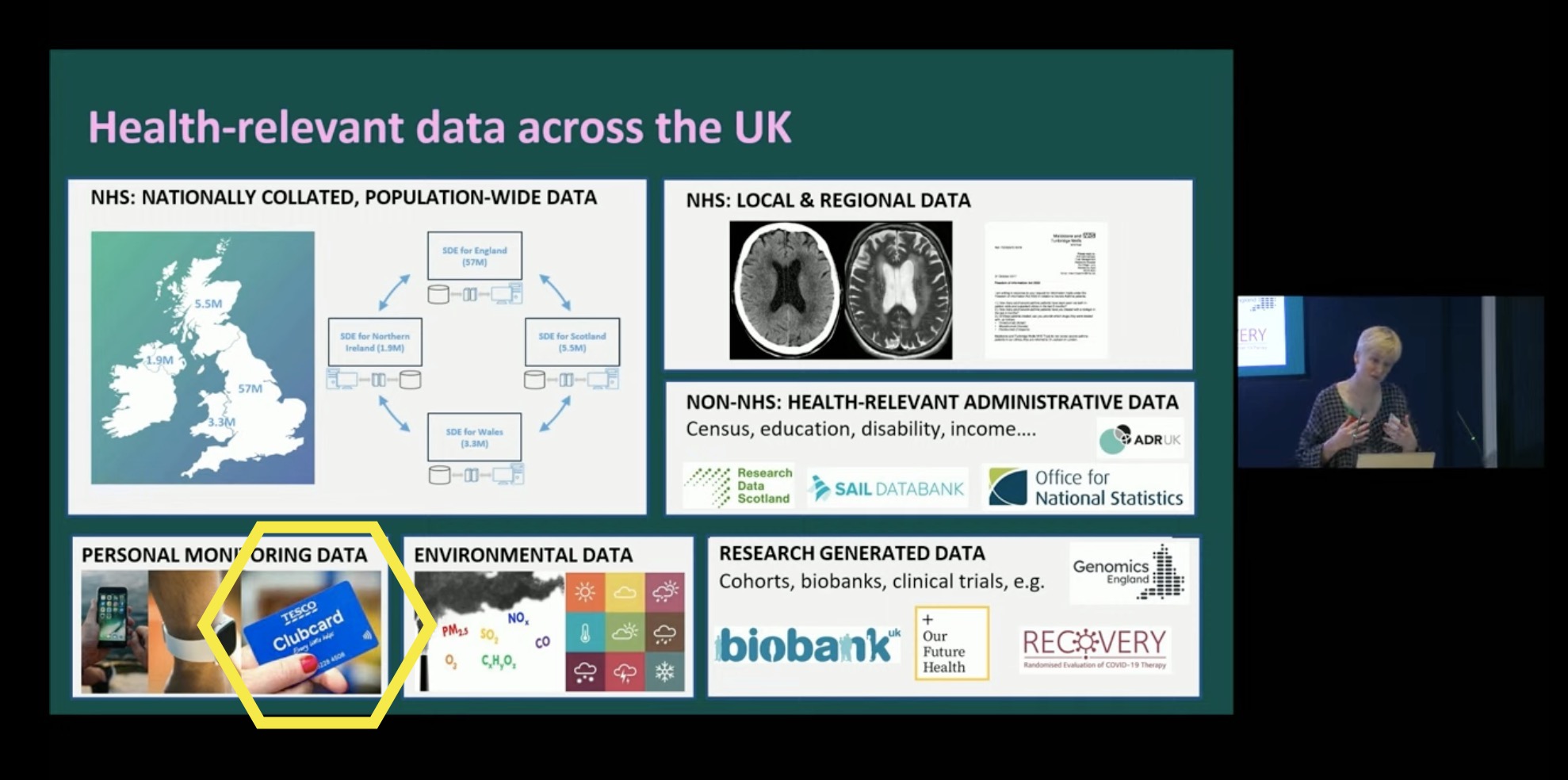
As described on page 167, Biobank wants the Department of Health in England to reuse data that was collected with the promise of “pandemic only”, and give it away to Biobank and others to hand out like any other NHS data. Buried on pg 102 is the desire to collect and share data from your smartwatch and on pg 103 your loyalty card. In practice, that would be the NHS collecting your smartwatch and loyalty card transactions and placing them in Palantir for Biobank and others to copy and rifle through.

One slide from the launch sums it up – it shows Clubcard data and smart watch data being copied to the NHS and onwards to research and commercial use – but that slide doesn’t mention the very controversial HMRC tax data that ONS and NHS are using to change waiting list priorities. Funny that…

Recent research shows that the smartwatch on your write can help diagnose a range of conditions earlier, but that level of detail can also be used to 

HDR/Sudlow: Biobank as the role model for more recklessness

Proposing that more data goes to Biobank to go to racists doesn’t grow the economy for everyone, it just grows some bank balances. Biobank believes that’s ok (still) because they pay Biobank’s fees.

Speaking at the launch, the report author said the goal was applicants getting data in “days” and proclaimed Biobank have “one of the best systems” for giving data out rapidly (without sufficient checks on who they gave it to).

We must note the Review author’s previous job from 2011-2019 which was getting more data for the disgraced regime at the UK Biobank during the period that the rules were watered down which meant Biobank handed the genetic data of the Biobank cohort to eugenicists, then moved to the mess that is HDR (the two organisations share a culture).  

Biobank continue to angrily deny that people connected to the organisation Biobank gave data to, including the EIDs field, have access to the EIDs field that Biobank gave them (the full investigation)

The Department of Health in England are auditing Biobank, but it’s unclear whether that audit will cover Biobank processes which led to the coverage in 2024, or whether the audit will be narrow and restricted only to questions around insurer access by the Guardian in 2023, possibly also excluding the story from 2022 about Biobank selling data to China (nothing seems to be happening about our 2024 followup to that – Biobank ignored our questions). Biobank’s main concern seems to be whether they have received money from applicants, only checking that the applicant isn’t on Biobank’s list of known racists to reject – a list that will always be incomplete.

The NHS application form is 30 pages, the Biobank version is only three pages. Biobank continue to insist that nothing in those 27 pages matters (and nothing in their contract with NHS England requires them to ask anything in those pages), but the checks are so laxthat Biobank didn’t spot an applicant was a bunch of eugenicists operating out of the same fake office as QAnon sites and other scams. That’s the approach HDR/Sudlow and ONS wants to all public sector data.

Biobank repeatedly argues that eugenicists keep trying to get Biobank data, and when Biobank catches them they’ll say no (pity about the cases they’ve said yes to). Biobank claim not to understand the approach of making multiple requests until it works, yet Biobank keep repeating their demands that data they should get Biobank think they deserve without following the rules, and will keep stomping their little feet (and getting meetings with Ministers) until they get what they want – the ripping up of promises to patients.

HDR/Sudlow’s friends shouldn’t have to keep their promises?

Unless patients can see how data is used, the government will get lobbied to break every promise they’ve ever made to patients whenever the day ends in “y”, because no patient can tell the difference. This report is another example of that – HDR/Sudlow Review agrees with Sudlow’s previous lobbying job that their friends should get a free pass out of their obligations.

Following the Review’s recommendation, DH have announced that they’re going to give the “pandemic only” GP data to Biobank and others under terms that are not limited to the Covid19 but will be for whatever Biobank, Our Future Health (and others) think they can do usefully with the data in future (and only they get to decide that, no one else has a say) 

HDR/Sudlow: only HDR’s Sockpuppets should be listened to

The Review says some things about consultation and engagement, picking winners from amongst consultation respondents by choosing those deemed a “good” consultee because they agree with what HDR/Sudlow wants to hear. HDR has form for this in designing an supposedly “open” call for applications in which UKRI will channel public funds to the “single collaborative bid” HDR chooses to support (the bid of their friends)

Unfortunately and embarrassingly for the authors, the HDR/Sudlow Review was so distracted by ensuring the Review only included the views of HDR that it forgot to suggest anyone else be invited to the group that supposedly should write the rules. The Review was so far in an echo chamber it forgot all it was listening to was itself.

According to HDR/Sudlow (pg 163), those that “would be well positioned to lead on SDE standards” is only “HDR UK [legal entity: HDR], ADR UK (partner with HDR but legally part of UKRI who fund HDR), the UK Health Data Research Alliance [legal entity: HDR], and UKRI’s Data and Analytics Research Environments UK (DARE UK) programme[legal entity: HDR]” and no one else. We have covered at length the ongoing subversion of safeguards by HDR as they continue their cash to cronies grants process and closed shop.

DH/E may be told they’re hearing from four organisations, but all bar one are sockpuppets controlled (in the data controller sense and in the practical sense) and owned by HDR where all the people in the room report up to HDR’s leader Andrew Morris and follow his party line.

Similarly, many of the public engagement groups of which HDR/Sudlow speaks supportively –  PEDRI [legal entity: HDR], DAREUK [legal entity: HDR], etc are again simply HDR hiding behind another logo. The one exception (UseMyData) have staff funded by HDR and other staff paid by NHS England to do engagement work – entirely legitimate but difficult to be considered independent from HDR’s desires around NHS data. 

Biobank and HDR want all data the NHS has, and they act as useful idiots for others who want that data for their own gain, including the Secretary of State who has an idea…

The Review was written to justify what was already being done

The NHS England announcement gives four examples where DH/E knows that there is a clear investment case to be made for funds, which is good for the bits of DH/E managing those waiting lists, but in a fixed budget imposed by HMT, that takes cash away from other treatments. 

Focussing on economic benefits means “economic growth” supplants clinical decision making and prioritisation. The more say HMT has, and the more control the Department of Health in England takes, the less choice your doctors have. 

The obesity work has already been done in the pilot, and now will be repeated with the other three areas (the work is being done by statisticians who like comparability). Ian Diamond talked about the work at the launch of the Sudlow Review where he disclosed that the existing work was done by ONS linking together taxpayer records with their health data, something the HDR/Sudlow review seems to have obfuscated in the Review itself.


All your health records and all your tax records linked, for departments to do with whatever they see fit. Once they’ve done these four areas, it is bureaucratically indefensible for not comparing all treatments across all of the NHS – what happens if there’s one that offers more benefit? But it will also show all treatments that have patient benefit but not measurable economic benefit. According to ONS (item 5.1 in April), the organisation making these decisions should be ONS, not the NHS. ONS makes decisions about the value of a statistical analysis, without any regard for the impact on patients or health.


ONS can do this because when NHS England gave them data for statistics purposes, NHS England chose not to respect the National Data Opt Out because it wasn’t identifiable data that would be linked onto your tax records (supposedly). Once ONS got the data for something, it can reuse it for  anything. The NHS England Advisory Group on Data was not entirely happy (section 5.1 in October) but NHS England doesn’t appear to care.


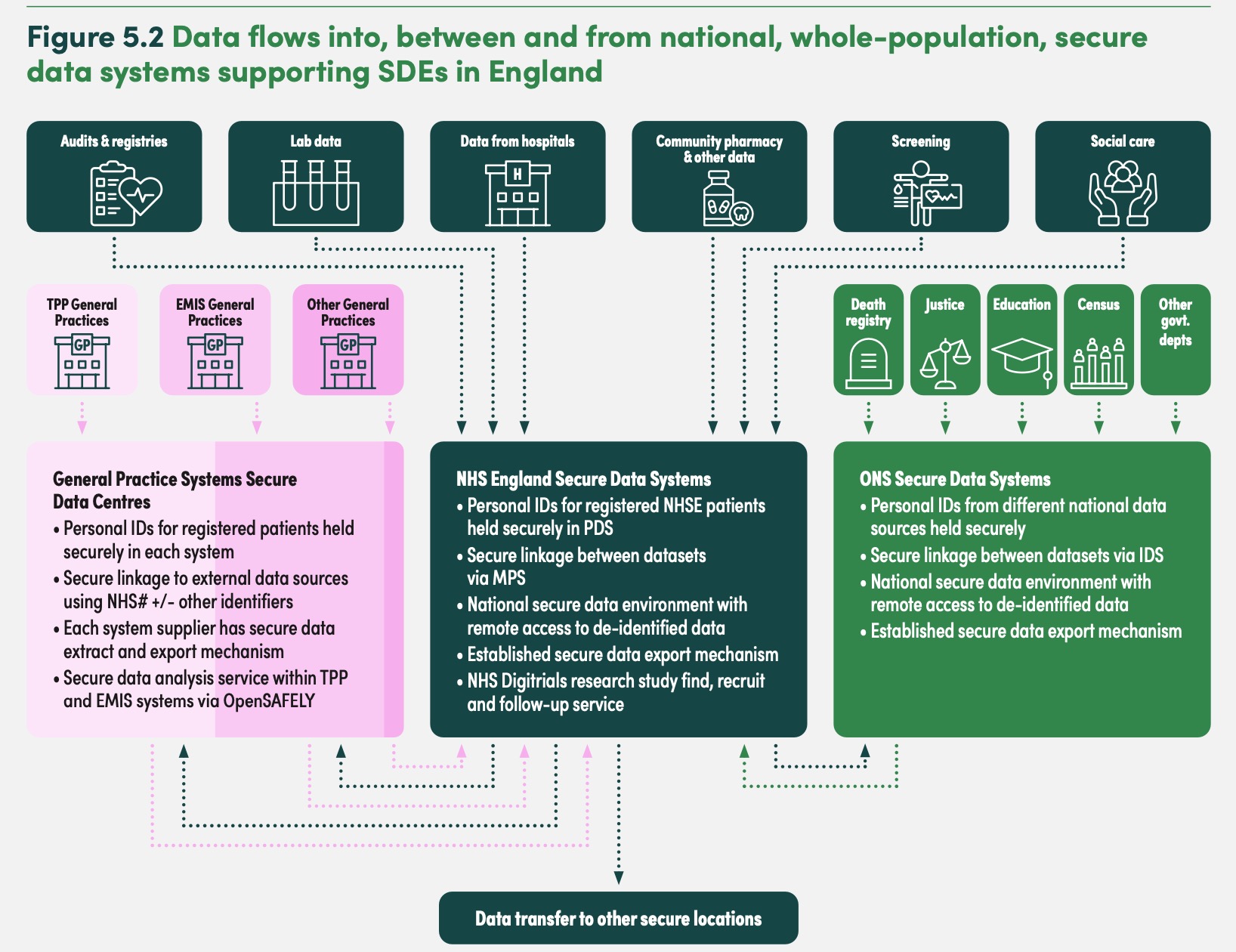
Despite the use of tax records being discussed at the launch of the Sudlow Review, the diagram on page 123 of the report notably omits HMRC taxpayer data being in the plans outlined by the Sudlow Review. The mention on page 90 is so opaque you could be entirely forgiven for missing that your tax records are being linked to your health records and data mined in ways you have no awareness of (while academic projects are publicly disclosed, projects internal to government are kept secret as clubcard culture has taken over the “digital centre of government”).

The HMRC/health data linkage is not used to give or refuse care – it is a model used to say what types of treatments help economic growth (and so should be treated faster), and which don’t (and so people can wait longer), in general terms, for people like you.

Simultaneously, DH/E is centralising waiting list cleansing and prioritisation in Palantir means DH/E will be centrally setting the criteria for who gets the limited resource of an operating theatre or specialist care, replacing centrally what is currently done by the doctors in your hospital making decisions based on clinical need.

Like equivalent analysts at US health insurers, ONS will claim their findings don’t affect your care, but it is intended to affect the priorities of care provided to people like you for care you may need in future. If the care you need doesn’t promote economic growth then being rich won’t help you, and if you happen to have a disease of the rich then your poverty doesn’t matter. It’s all about “in general” not you specifically. But, diseases of London have a bigger impact on the economy than diseases of Blackpool or the North, so waiting lists in London should be prioritised according to the logic that the previous government used to start the NHS down this analysis path.

The Everyone Database: names, addresses, dates of birth, and all the identifiers used for you across Government linking all the data government has

I’ve previously sat in a UKRI meeting where a Professor spoke at length that he was not suggesting creating a population index or population register, while his slide behind him said he was, and he wanted it to be based on the NHS patient register. They had invited no one from the NHS to that meeting – they weren’t aware (until we told them). “Population Research UK” (another HDR sockpuppet) seems to have got them to do it anyway.  If the meetings of that have started, has anyone from ONS noticed that everyone they’re talking to is basically Andrew Morris in a disguise?

On page 123 the Review discloses what the Database is, and at the review launch, National Statistician Ian Diamond disclosed ONS had already built the “demographic index” and are using it as the link between tax and health records in order to do the analysis of which care to prioritise and which to deprioritise (ie cut).

The inclusion of justice data is particularly troubling – given it is a database of the victims of crime, not just perpetrators, mostly because HDR/Sudlow didn’t bother to think of those in any database as people with rights or concerns (or think of them as people at all).

The National Statistician has a choice

Speaking in 2021, Sir Ian Diamond, National Statistician said:

“There’s no god given right for us to have data. There needs to be a really sound public good reason for collecting data, and using data, and people need to feel absolutely comfortable that their data are being used properly and kept securely and in a way that satisfies all forms of privacy”

Does the National Statistician still believe that? If someone isn’t comfortable with that, for demonstrably good reasons, does the National Statistician want to use their data anyway? How does someone opt out?

At the HDR/Sudlow Review launch, he repeatedly talked about data being “used properly”.

Does “used properly” include the economic analyses that DH/E have announced being done on the data of people who have opted out of their data being used for purposes beyond direct care?

Does “used properly” include using the tax records of people who are given no choice about that at all?

As currently built, the ONS Population Index includes the NHS identifiers of everyone, but could easily have a second field which is only the NHS identifiers of people who have not got a national data opt out, and it is that second field which is used for research purposes. Until DSIT gives a “rest of government opt out” the “NHS national data opt out” is available, especially for NHS uses. The existence and scope for abuse of the Population Index is an entirely different problem (noting also that the spooks want access to everything any entity in the UK uses for anything). What happens when Home Office staff walk across the corridor from their open plan office into the ONS open plan office in the same building and want special access to data?

Some of the other simpler issues can resolve themselves – transparency will come to ONS either voluntarily or from outside. ONS can request a second dataset to which the National Data Opt Out has been respected, which is used for all research proposals (as AGD recommended); or as the HDR/Sudlow Review suggested for Biobank and the Department of Health in England, do promises only apply when it’s easier to keep them than not? Will ONS treat the census the same way?

ONS claims some abstract sense of “public support” for what they do, but they want data this way because public support for their work, in the very real measure of response rates to their flagship survey, is only 20% and falling. ONS claims of public support do not stand up against their own response rates.

== 

(some of these issues came up at the UK Statistics Assembly on 22 January, where we were a discussant in a session)

For those who have followed medConfidential’s team since the 2000s, the institutional funders who focussed on these topics under the previous labour government seem to have moved on to other areas. We remain grateful for individual donations.